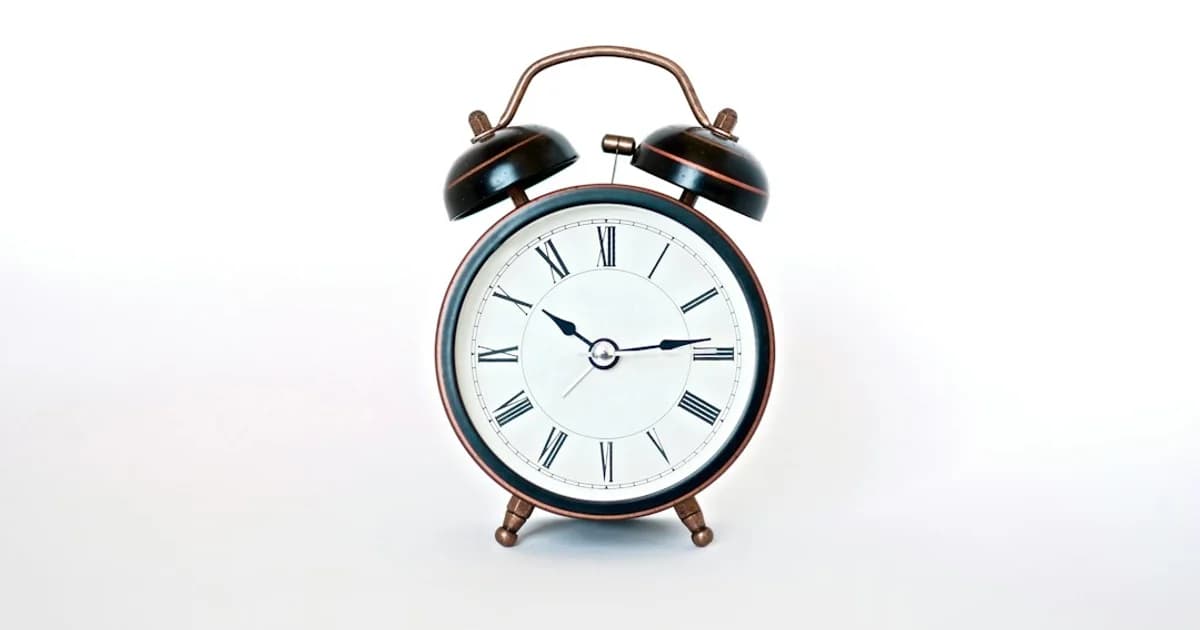
To adjust your baby's schedule for daylight saving time, move wake-up, naps, meals and bedtime about 15 minutes a day in the direction the clocks will change, starting 4 days before, so your baby is already on the new clock's rhythm by the change day. The AAP suggests nudging naps and bedtime "a few minutes each day," ideally starting about a week ahead, and says most children adjust within about a week (AAP).
If you didn't prepare, two simpler options work too: split the difference for a few days, or switch to the new clock on the day. Below are the next clock-change dates, sample plans for spring forward and fall back, and how to use light, darkness and routine to speed things up.
When do the clocks change next?
| Region | Forward (lose 1 hour) | Back (gain 1 hour) |
|---|---|---|
| US, most of Canada | Sun, Mar 14 (2 a.m.) | Sun, Nov 7 (2 a.m.) |
| UK | Sun, Mar 28 (1 a.m.) | Sun, Oct 31 (2 a.m.) |
| EU | Sun, Mar 28 | Sun, Oct 31 |
| Australia* | Sun, Oct 3 | Sun, Apr 4 (3 a.m.) |
*NSW, Victoria, South Australia, Tasmania and the ACT. Sources: NIST (US rule: second Sunday of March, first Sunday of November); GOV.UK; European Commission (last Sunday of March and October); NSW Government.
Not everyone changes. Hawaii and most of Arizona stay on standard time (NIST), British Columbia made its last change on March 8, 2026 (Government of B.C.), and Queensland, Western Australia and the Northern Territory don't use daylight saving (NSW Government). In the US, the House passed a bill to make daylight saving time permanent in July 2026 (House roll call), but it only becomes law if the Senate passes it and it's signed, so check closer to the date.
Free tool
Daylight Saving Time Baby Sleep Planner
Enter your baby's usual wake-up, nap and bedtimes and get a day-by-day plan for the next clock change.
What the time change does to your baby's sleep
Your baby's body clock runs on light and darkness, not on the clock on the wall. The American Academy of Sleep Medicine calls light and darkness "the most powerful timing cues" for sleepiness and alertness (AASM). When the clocks move, your baby's internal rhythm stays put for a while:
- Spring forward: a baby who woke at 7:00 tends to wake around 8:00 by the new clock, and the usual bedtime arrives an hour before they feel tired. The AAP notes the spring change may be a little easier on young children, who tend to be early risers. The hard part is usually bedtime.
- Fall back: a baby who woke at 7:00 now wakes around 6:00. The AAP says the fall change can make younger kids "crash" before bedtime and wake earlier than usual.
Young babies are a special case. Babies don't have regular sleep cycles until about 4 months (AAP), so there's little schedule to shift. Keep feeding on cue and following sleepy signs, and let the day drift to the new clock.
What the research shows. There are almost no studies of daylight saving time in babies. A 2025 systematic review of 27 studies in people aged 6 to 85 linked the spring change to shorter, poorer sleep and more sleepiness, but found the evidence too mixed for firm conclusions (Romigi et al. 2025). In high school students, sleep fell by an average of 32 minutes on school nights in the week after the spring change (Medina et al. 2015). The tips for babies below come from how the body clock works and from pediatric and sleep-medicine advice, not from trials.
GrowthKit for iPhone
Plot every measurement on the WHO charts.
Percentiles, growth velocity and a PDF for your pediatrician. Free to download, with a free trial.

Three ways to adjust your baby's schedule
| Method | When to start | How it works | Often suits |
|---|---|---|---|
| Gradual (15 minutes a day) | 4 days before | Move wake-up, naps, meals and bedtime 15 minutes a day until you've shifted a full hour | Most babies, especially sensitive sleepers |
| Faster (30 minutes a day) | 2 days before | The same idea in two bigger steps | Busy weeks, easygoing sleepers |
| Split the difference | On the change day | Set every time 30 minutes off the new clock for about 3 days, then go to your usual times | When you didn't prepare |
| Switch on the day | On the change day | Use your usual clock times from the first morning and let light and routine do the rest | Flexible sleepers, many toddlers |
Source: gradual shifting from the AAP ("a few minutes each day") and the AASM (15–20 minutes a night for a few nights, written for adults). The step sizes and "often suits" are common practice; no study has compared these methods in babies.
Whichever you choose, move the whole day, not just bedtime. If wake-up stays the same while bedtime shifts, naps and the evening stretch get out of balance. Keep the bedtime routine itself identical. For typical nap counts and bedtimes by age, see the baby sleep schedule by age.
Spring forward: a sample plan
This example is a baby who usually wakes at 7:00 am, naps at 9:30 am and 2:00 pm, and goes to bed at 7:00 pm. With the gradual method, everything moves 15 minutes earlier each day:
| Day | Wake | Nap 1 | Nap 2 | Bedtime |
|---|---|---|---|---|
| Wed, Mar 10 | 6:45 am | 9:15 am | 1:45 pm | 6:45 pm |
| Thu, Mar 11 | 6:30 am | 9:00 am | 1:30 pm | 6:30 pm |
| Fri, Mar 12 | 6:15 am | 8:45 am | 1:15 pm | 6:15 pm |
| Sat, Mar 13 | 6:00 am | 8:30 am | 1:00 pm | 6:00 pm |
| Sun, Mar 14 (after clocks go forward) | 7:00 am | 9:30 am | 2:00 pm | 7:00 pm |
By Saturday your baby is living on what will be the new clock, so Sunday's times read as normal. In the UK and EU, use the same pattern counting back from March 28. To get these times for your own baby's routine, use the day-by-day clock-change planner.
Bedtime battles. After the spring change, bedtime is lighter outside and your baby may not feel ready. What helps:
- Get morning light. Open the curtains or head outside soon after your baby wakes, and dim the lights in the evening (AASM).
- Darken the room. Room-darkening shades help in spring and summer. Choose cordless ones, and move the crib away from windows and window-covering cords: about nine children under 5 die each year from strangling in window-covering cords (CPSC).
- Keep screens off before bed. The AAP advises putting screens away at least an hour before bedtime (AAP).
Fall back: a sample plan and early waking
For the same baby, the fall plan moves everything 15 minutes later each day:
| Day | Wake | Nap 1 | Nap 2 | Bedtime |
|---|---|---|---|---|
| Wed, Nov 3 | 7:15 am | 9:45 am | 2:15 pm | 7:15 pm |
| Thu, Nov 4 | 7:30 am | 10:00 am | 2:30 pm | 7:30 pm |
| Fri, Nov 5 | 7:45 am | 10:15 am | 2:45 pm | 7:45 pm |
| Sat, Nov 6 | 8:00 am | 10:30 am | 3:00 pm | 8:00 pm |
| Sun, Nov 7 (after clocks go back) | 7:00 am | 9:30 am | 2:00 pm | 7:00 pm |
If you'd rather not keep your baby up later before the change, split the difference instead: from the change day, put your baby down at 6:30 pm and aim for 6:30 am wake-ups for about 3 days, then move to 7:00.
Early waking is the main fall problem. Your baby's body thinks 6:00 is 7:00. To nudge the clock:
- Keep it dark until your target wake time. The AASM advises keeping light exposure low until the target morning wake time after the fall change (AASM).
- Keep early wake-ups boring. Quiet and dim, like a night waking. If your baby is hungry, feed them, then start the day at the new time.
- Hold naps close to the new times so the evening doesn't become an overtired stretch. A wake windows chart by age gives a rough idea of how long that stretch can run.
Naps, feeds and safe sleep during the change
- Naps move by the same steps as wake-up and bedtime. If a nap runs short during the transition, an earlier bedtime that night is a common fix.
- Feeds: young babies keep feeding on cue; the clock change doesn't change hunger. Shift scheduled meals and snacks along with naps. The AASM also suggests moving mealtimes with your new schedule, and the AAP suggests an earlier dinner before the spring change for older kids.
- Melatonin isn't a time-change fix. The AAP says melatonin is not a sleeping pill and should only be used after a discussion with your pediatrician. From 2012 to 2021 there were more than 260,000 reports of children's poisonings involving melatonin (AAP).
Toddlers: bedtime battles and the toddler clock
Toddlers often notice the change more than babies, because they can protest it. The AAP's toddler bedtime advice applies here: a quiet routine before bed, the same bedtime every night, and not returning to the room every time they call out once you know they're safe (AAP).
For early risers after the fall change, many families use a toddler clock that changes color at the time it's OK to get up. Set it to your target wake time, or move it 15 minutes later every few days. It's a widely used tool, but there's no research on it, so treat it as a helpful cue rather than a fix. Check how much sleep your toddler needs in how much sleep a baby needs by age.
How long does it take a baby to adjust?
Most children adjust within about a week (AAP). If you switch on the day rather than shifting gradually, expect a few early mornings or late bedtimes first.
If sleep is still off after a week or two, the clock change may not be the only cause. Illness, a new skill or a sleep regression can overlap with the time change. Talk with your pediatrician if your child keeps having trouble sleeping, or sooner if they seem unwell.