From 12 to 24 months, most toddlers need about 16 oz (2 cups) of whole milk a day (AAP, HealthyChildren.org). The 2019 expert consensus behind that advice gives a range of 16–24 oz (2–3 cups) at this age, then up to 16 oz at 2–3 years and up to 20 oz at 4–5 years (Healthy Eating Research consensus). Drinking more than 24 oz a day has been linked to iron deficiency in toddlers who don't get enough iron from food (AAP).
Milk is a useful drink, not a meal. Two cups cover most of a toddler's calcium and leave room for the iron-rich foods that milk can't replace.
How much milk by age
| Age | Milk | Water | 100% juice |
|---|---|---|---|
| Under 12 months | No cow's milk to drink; breast milk or formula | From about 6 months: 4–8 oz (½–1 cup) | None |
| 12–24 months | About 16 oz (2 cups) of whole milk; consensus range 16–24 oz | 8–32 oz (1–4 cups) | Not needed; if offered, no more than 4 oz |
| 2–3 years | Up to 16 oz (2 cups) of skim or low-fat milk (see milk fat below) | 8–32 oz (1–4 cups) | No more than 4 oz |
| 4–5 years | Up to 20 oz (2½ cups) of skim or low-fat milk (see milk fat below) | 12–40 oz (1½–5 cups) | No more than 4–6 oz |
Source: Healthy Eating Research 2019 consensus (AAP, AHA, Academy of Nutrition and Dietetics, AAPD), as reproduced by the AAPD; AAP, HealthyChildren.org. 1 cup = 8 oz (about 240 mL).
These are upper guides, not targets. The consensus notes that how much milk a toddler needs depends on how much solid food they eat. HealthyChildren.org's simplified chart lists 16–24 oz for the whole 2–5 range, so you'll see both numbers; neither source goes above 24 oz a day before age 5. For water at every age, see when babies can have water.
GrowthKit for iPhone
Plot every measurement on the WHO charts.
Percentiles, growth velocity and a PDF for your pediatrician. Free to download, with a free trial.

Whole, 2% or low-fat milk?
From 12 to 24 months: whole milk for most toddlers (HealthyChildren.org). The 2025–2030 Dietary Guidelines also say to stop formula at 12 months and give whole milk (DGA 2025–2030). Your pediatrician may suggest reduced-fat (2%) milk instead if weight gain is fast or there's a family history of obesity, high cholesterol or heart disease (HER consensus; AAP).
From age 2, sources now differ:
- The AAP and the 2019 consensus recommend skim (fat-free) or low-fat (1%) milk.
- The 2025–2030 Dietary Guidelines say to include full-fat dairy with no added sugars, and call full-fat dairy important for children's energy needs and brain development.
Ask your pediatrician which suits your child; lower-fat milk has as much calcium as whole milk. Whatever the fat level, keep to the amounts in the table and skip flavored milk. Both sources advise against added sugars for young children, and the consensus doesn't recommend flavored milk at any age under 5.
What happens if a toddler drinks too much milk?
Iron deficiency. The AAP says more than 24 oz a day has been associated with iron deficiency in toddlers who don't get enough iron elsewhere (AAP). There are three reasons:
- Milk has almost no iron. MedlinePlus calls it "a very poor source of iron" (MedlinePlus). Three cups of whole milk contain about 0.2 mg of iron (calculated from USDA FoodData Central), while toddlers aged 1–3 need 7 mg a day (MedlinePlus).
- It crowds out food. A cup of whole milk has about 150 calories (USDA), so 24 oz is roughly 450: half or more of the 700–1,000 calories a 12- to 23-month-old needs in a day (Dietary Guidelines 2020–2025). Children who drink large amounts of milk and eat few other foods can develop "milk anemia" (MedlinePlus).
- It blocks some iron absorption. Milk's calcium and casein reduce how much plant (nonheme) iron the body absorbs (Ziegler 2011).
Hidden blood loss from the gut, the other well-known mechanism, mainly affects babies given cow's milk before 12 months and stops after age 1 (Ziegler 2011). It's one reason cow's milk waits until the first birthday.
In a Canadian study of 1,311 healthy children aged 2–5, more milk went with lower iron stores. Two cups a day kept vitamin D at a healthy level with little effect on iron for most children, and children still drinking from a bottle had bigger drops in iron stores (Maguire et al. 2013). The AAP's 2026 iron guidance again stresses limiting excessive milk after age 1 (HealthyChildren.org). Our guide to iron deficiency and anemia in children covers the signs and the hemoglobin check at 12 months.
Constipation. The AAP's symptom checker says milk and cheese are the only foods that in high amounts can cause constipation, typically with hard, pale stools. For constipated children over 1, it suggests limiting milk products (milk, cheese, yogurt, ice cream) to 3 servings a day (HealthyChildren.org). For other causes and remedies, see easing constipation in toddlers.
Free tool
Child Iron Needs Calculator
See your child's daily iron target by age and diet, and how milk fits in.
Switching from formula and bottles at 12 months
Before 12 months, no cow's milk as a drink. It can stress immature kidneys, lacks enough iron and vitamin C, and can irritate the gut and cause blood loss (AAP).
At 12 months, swap formula for whole milk (DGA 2025–2030). Offer it in a cup with meals and snacks.
Move from bottle to cup. The AAP suggests offering a cup from about 6 months, finishing the switch sometime between 12 and 18 months, and drinking from an open cup by about age 2. Start by allowing the bottle only at mealtimes, then drop the rest, especially at naps and bedtime, since teeth that are constantly bathed in milk can decay (AAP). In the Canadian study above, bottle use was also linked to bigger drops in iron stores.
Skip toddler formula. The AAP's 2023 clinical report found that "toddler" and "transition" formulas are generally unnecessary and nutritionally incomplete, and offer no benefit over much less expensive cow's milk for most children older than 12 months (AAP, HealthyChildren.org; Fuchs et al. 2023). The 2019 consensus doesn't recommend toddler milks either, noting they can add sugars and undermine breastfeeding.
Breastfed toddlers, plant milks and raw milk
Breastfeeding. The AAP supports breastfeeding along with solid foods for 2 years or beyond, as long as mother and child want to (AAP 2022). Breast milk counts as one of your toddler's milk drinks; the drinks consensus didn't set amounts for it. Ask your pediatrician how much cow's milk, if any, to add.
Plant milks. The AAP considers fortified soy milk nutritionally equivalent to cow's milk and an acceptable alternative (HealthyChildren.org). Other plant drinks, such as oat and almond, usually have less protein and fat than cow's milk (Morency et al. 2017). The consensus advises using plant milks as a full replacement only for a medical reason, such as a milk allergy, or a dietary choice, such as a vegan diet, and with a health professional's help. Rice drinks aren't advised under age 5 because of arsenic (NHS). See calcium for kids for dairy-free calcium sources.
Milk and your toddler's growth
Milk supports growth in moderate amounts. Two cups supply most of the 700 mg of calcium a 1- to 3-year-old needs, but extra calcium won't make a well-fed child taller (calcium for kids).
What a toddler drinks instead of milk may matter. In a Canadian study of 5,034 children aged 2–6, each daily cup of a non-cow's-milk drink (such as soy or almond) went with 0.4 cm less height. A 3-year-old drinking 3 cups of non-cow's milk a day was about 1.5 cm shorter than one drinking 3 cups of cow's milk (Morency et al. 2017). That's an observational finding and can't prove cause, but it's a reason to choose a plant milk with care.
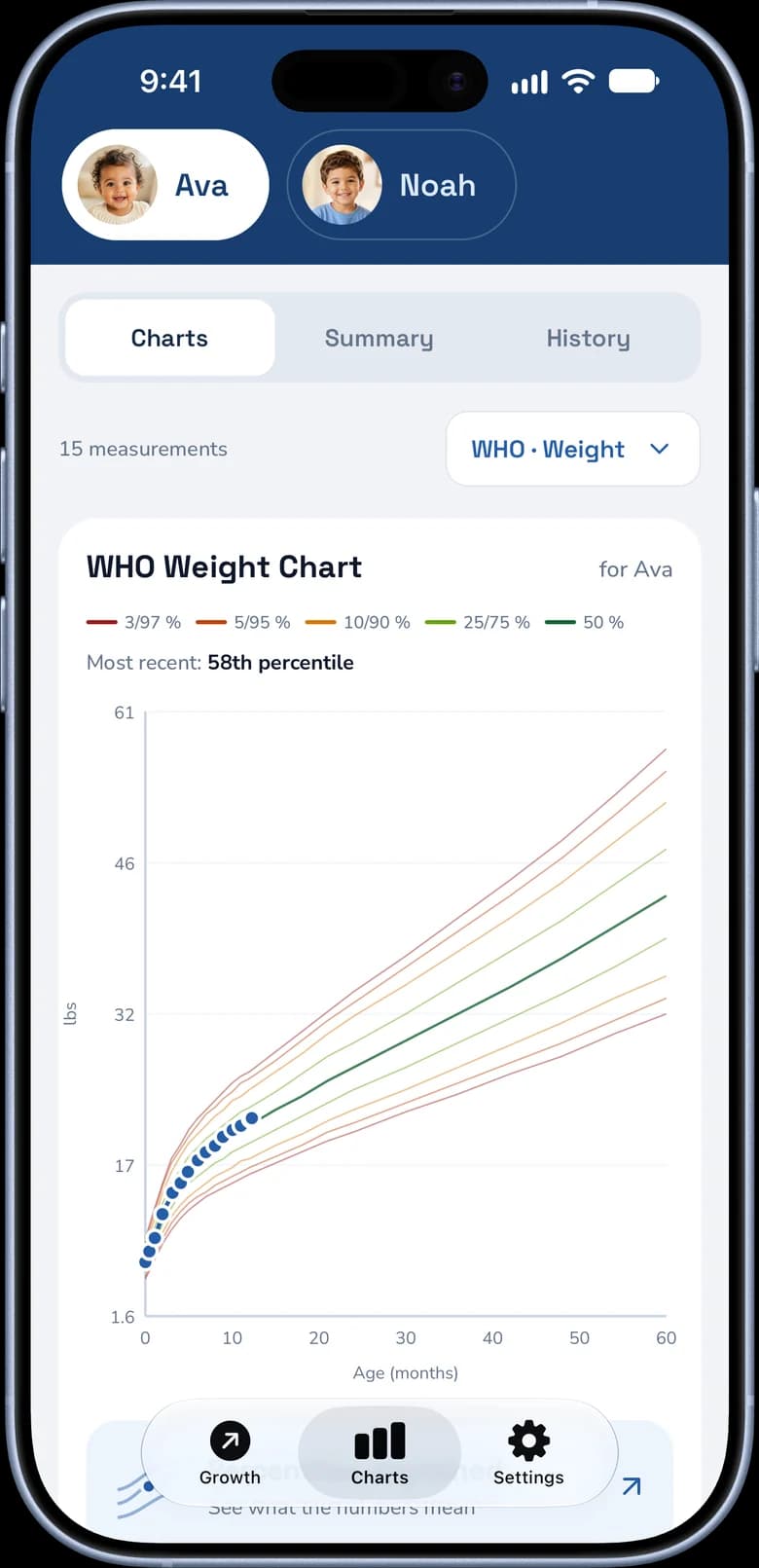
Too much milk works the other way: the iron deficiency it can cause brings tiredness and poor appetite. If your toddler drinks a lot and eats little, keep an eye on the growth chart. A height or weight curve that drifts down across percentile lines is worth raising with your pediatrician. GrowthKit doesn't log drinks or meals, but it plots height and weight on WHO charts, so you can see whether growth stays on its curve while you adjust how much milk your toddler drinks.
Free tool
Toddler Portion Size Guide
Look up typical toddler servings for each food group, including milk, by age.
When to talk to your pediatrician
- Your toddler drinks more than 24 oz of milk a day, or still takes bottles of milk after about 18 months.
- Your child seems pale, tired or irritable, has a poor appetite, or craves ice or dirt. Ask about an iron check.
- Hard, pale stools or constipation along with a lot of milk and cheese.
- A milk allergy, vegan diet or a child who refuses milk, and you're not sure calcium, vitamin D and protein are covered.
- Growth slowing: height or weight dropping across percentile lines.
For a full day of toddler meals that leaves room for 2 cups of milk, see the toddler meal plan.