
When Do Babies Start Walking? Average Age and Red Flags for Late Walking
Most babies take their first steps between 9–12 months and walk well by 14–15 months. Learn what's normal, how to help, and when late walking warrants a doctor visit.
 Srivishnu RamakrishnanApril 9, 20269 min read
Watching your baby take their first steps is one of the most anticipated milestones of the first year — and one of the most variable. Some babies are walking steadily at 9 months old. Others are waving goodbye from the sofa at 15 months while they contemplate whether to stand up. Both are entirely normal, and the wide natural variation in walking age causes disproportionate parental worry.
The Walking Timeline: What's Normal at Each Stage
Independent walking doesn't happen suddenly. It is the culmination of many months of progressive motor development. Understanding the sequence helps parents recognise whether their baby is developing the prerequisite skills even if the final independent steps haven't arrived yet.
| Milestone | Average Age | Normal Range | What It Demonstrates |
|---|---|---|---|
| Rolls from back to front | 5–6 months | 4–7 months | Core strength, body rotation |
| Sits independently | 6–7 months | 5–9 months | Trunk stability, balance |
| Pulls to stand | 9 months | 7–11 months | Leg strength, motivation to be upright |
| Cruises (along furniture) | 10 months | 9–12 months | Weight shifting, walking mechanics |
| Stands unsupported briefly | 10–11 months | 9–12 months | Balance and core strength |
| First independent steps | 12 months | 9–15 months | Balance + leg strength + confidence combined |
| Walks well independently | 13–14 months | 10–18 months | Coordination refinement |
Source: CDC Developmental Milestones; WHO Motor Development Study (2006)

GrowthKit · Free for iPhone
Track every milestone, instantly.
What Babies Are Doing Before They Walk
Six months before their first steps, most babies are actively building the physical prerequisites for walking:
Pulling to stand (7–10 months): Babies grab furniture, cots sides, or legs and haul themselves upright. This builds the quadricep and hip flexor strength needed to support body weight. A baby who is not yet pulling to stand by 12 months warrants discussion with your paediatrician.
Cruising (9–12 months): Sideways walking along furniture is walking practice with support — the body is learning to shift weight from one leg to the other, the core mechanic of bipedal locomotion.
Standing independently (10–12 months): Letting go briefly before lowering back down demonstrates balance emerging without external support. Many babies do this repeatedly for a few weeks before trusting themselves to take a step.
First steps: Often tentative and followed by a fall. Babies typically take 2–3 steps then fall for several weeks before the gait smooths out. Expect falls to be frequent — a new walker can fall 50–100 times per day as they calibrate.
How to Support Your Baby's Walking Development
Babies are intrinsically motivated to walk — their parents don't need to teach them. But creating an environment that is physically supportive accelerates the process:
Maximise floor time: Babies who spend significant time in walkers, jumpers, and bouncers spend less time developing the balance and muscle strength needed for independent walking. The AAP advises against traditional wheeled baby walkers (and they are banned in Canada) due to both safety and developmental concerns.
Furniture arrangement: Place low, stable furniture (sofa, coffee table, sturdy toy boxes) in accessible clusters so babies can practise cruising from one piece to another. The gaps between pieces gradually increase as confidence grows.
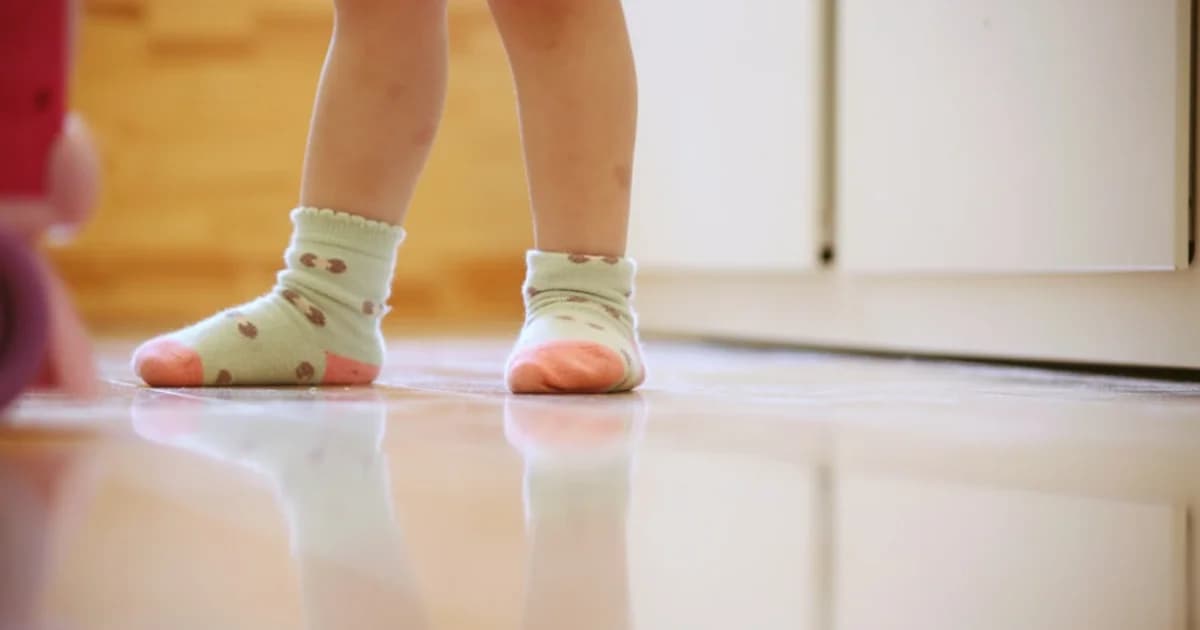
Barefoot walking on safe surfaces: Shoes are generally not needed until a child is walking outdoors regularly. Bare feet provide better proprioceptive (underfoot sensation) feedback and grip, both of which assist balance development. Gripper socks are a reasonable compromise indoors.
Hold fingers, not arms: When assisting a child learning to walk, hold two fingers at their height rather than raising their arms overhead. Overhead holding distorts their balance and doesn't replicate the mechanics of independent walking.
Baby Walking Age Range
See the expected age range for walking milestones and where your baby's development sits relative to typical timelines.
Walking Style: What's Normal in New Walkers
New walkers look different from experienced ones. Normal walking features in 12–18 month olds include:
- Wide-based gait: Feet spaced further apart than hip width for stability
- Arms raised: "High guard" position (arms up, elbows bent) for balance
- Flat-footed: Arches of the feet are not yet visible — flat feet are normal until age 3–4
- Toe-walking: Common in the first 6 months of walking as a balance experiment
- Frequent falls: Very normal — 17 falls per hour has been recorded in research on new walkers
All of these features typically resolve without intervention as walking experience accumulates.
Red Flags: When to See Your Paediatrician
Most late walkers simply need more time. Some late walkers benefit from physiotherapy even when there is no underlying condition. A minority have an underlying condition requiring diagnosis.
Discuss with your paediatrician soon if:
- Not walking by 18 months (the standard clinical referral threshold)
- Pulls to stand but never attempts to cruise along furniture by 12–13 months
- Was crawling and cruising but stopped doing so
- Walking is consistently asymmetric (favours one side strongly)
- Persistent tiptoe walking on every step after 24 months
Seek assessment promptly if:
- No pulling to stand by 12 months alongside other developmental concerns
- Developmental regression (losing previously achieved motor skills) at any age
- Very low muscle tone visible — floppy limbs, difficulty holding head up, resistance to weight-bearing
- A strong family history of muscular dystrophy
| Scenario | Action | Reason |
|---|---|---|
| 13 months, bum-shuffler, no steps yet | Mention at next visit; monitor | Bum-shufflers walk later — still normal range |
| 15 months, cruises well, taking first steps | Normal — no action needed | Well within 18-month window |
| 17 months, cruising but no independent steps | Raise at next well visit; physio referral reasonable | Approaching threshold; early physio helpful |
| 18 months, no independent walking | Same-week paediatric appointment | Clinical referral threshold met |
| Any age, previously walked but stopped | Urgent: same-day or next-day appointment | Regression is always a red flag |
Baby Milestone Checker
Review your baby's developmental milestones against CDC and WHO standards and identify any areas to discuss with your paediatrician.
After the First Steps: Expecting the Learning Curve
Independent first steps are rarely steady — they are tentative, wide-based, and frequently interrupted by sitting down. Most children go from first independent steps to competent walking over 2–4 months. By around 18 months, most toddlers are walking with confidence, starting to run, and attempting stairs with support. Toddler motor development covers the full 12–36 month movement sequence.
For the motor sequence that leads to walking — tummy time, rolling, sitting — tummy time for babies explains how each stage enables the next. A parent who observes "my baby took three steps today" at 12 months and another who observes "my baby doesn't walk yet" at the same age may have children who will both be walking well by 13–14 months. The duration between first steps and confident walking varies as much as the onset age.
Frequently Asked Questions
What is the average age babies start walking?
The average age for first independent steps is around 12 months, but the normal range extends from 9 to 15 months. Most paediatricians consider a child a 'late walker' only if they are not walking independently by 18 months — which triggers a developmental referral. A child who walks at 15 months is entirely within the normal range, not delayed.
My baby is 14 months and not walking — should I be worried?
At 14 months, many babies are still not walking independently and that is within normal range. The 18-month mark is the clinical threshold for concern. Between 14–18 months, it is reasonable to mention it to your paediatrician at the next visit, especially if there is no crawling or cruising (walking along furniture). They may recommend physiotherapy as a proactive measure, but it is not an emergency.
What are the stepping stones to walking?
Walking develops through a sequence: pulling to stand (7–10 months), cruising along furniture (9–12 months), standing briefly unsupported (9–12 months), taking first steps with support (10–12 months), and independent first steps (9–15 months). Children who skip or significantly delay any of these earlier stages may benefit from earlier physiotherapy assessment.
Does walking on tiptoes mean something is wrong?
Occasional tiptoe walking before age 2 is common and usually harmless — many new walkers experiment with tiptoeing as they develop balance and body awareness. Persistent tiptoe walking (toe-walking on every step after age 2), or tiptoe walking combined with other developmental concerns, warrants a paediatric assessment to rule out tight heel cords (Achilles tendon contracture) or neurological causes.
Medical Disclaimer
This article is for informational purposes only and does not constitute medical advice. Always consult your child's pediatrician or a qualified healthcare provider for any health-related concerns.Free Tools
More Milestones & Development
Free Tools
More Milestones & Development