To measure your baby's length at home, lay them on their back on a firm, flat surface with the top of their head against an upright board or wall. A second person straightens the knees and holds both feet flat against another upright board, and you measure the distance between the two boards. The American Academy of Pediatrics says two people are needed, and babies are measured lying down until 24 months.
Home lengths are useful for seeing a trend between checkups, but they're harder to get right than weight. Below: what you need, the exact steps, the mistakes that make a baby look shorter than they are, and what to do with the number. For weight and head size too, see our hub guide on how to track baby growth at home.
What you need
- A second adult. This is the one thing you can't skip.
- A firm, flat surface: a table or the floor. Not a bed or changing pad, which sink.
- Something fixed and upright for the head: a wall, or a heavy box or hardcover book standing on end.
- Something flat to slide against the feet: another hardcover book or a cutting board.
- A non-stretch tape measure (or a baby measuring mat with a fixed headboard and sliding footboard, which makes it easier).
- A pencil and your record: a notebook, spreadsheet or app.
Take off hats, hair clips, buns, shoes and socks first (AAP). Choose a time when your baby is calm and relaxed.
How to measure baby length: step by step
These steps follow the technique the AAP sets out for clinics, adapted for home:
- Lay your baby on their back, body flat and centered, with the crown of the head touching the headboard or wall.
- Person 1 holds the head gently against the board, with your baby looking straight up. Clinically, the ear canal and the lower edge of the eye socket line up vertically, at right angles to the table. If your baby's chin is tucked to their chest, gently untuck it.
- Person 2 straightens the legs. Press gently on the knees until the legs are flat, and hold both ankles.
- Bring the footboard up against the soles so both feet are flat on it with the toes pointing up. Keep the board upright, not tilted.
- Read or mark the length between the inside of the headboard and the footboard. Record it to the last completed 0.1 cm (or ⅛ in): round down, not to the nearest.
- Lift the footboard away, then repeat. If the two numbers differ noticeably, measure a third time and use the middle one.
If your baby is upset and you can't hold both legs straight, the AAP allows measuring with one leg held straight. If it's still not working, stop and try another day. A struggling baby gives a number that's mostly noise.
GrowthKit for iPhone
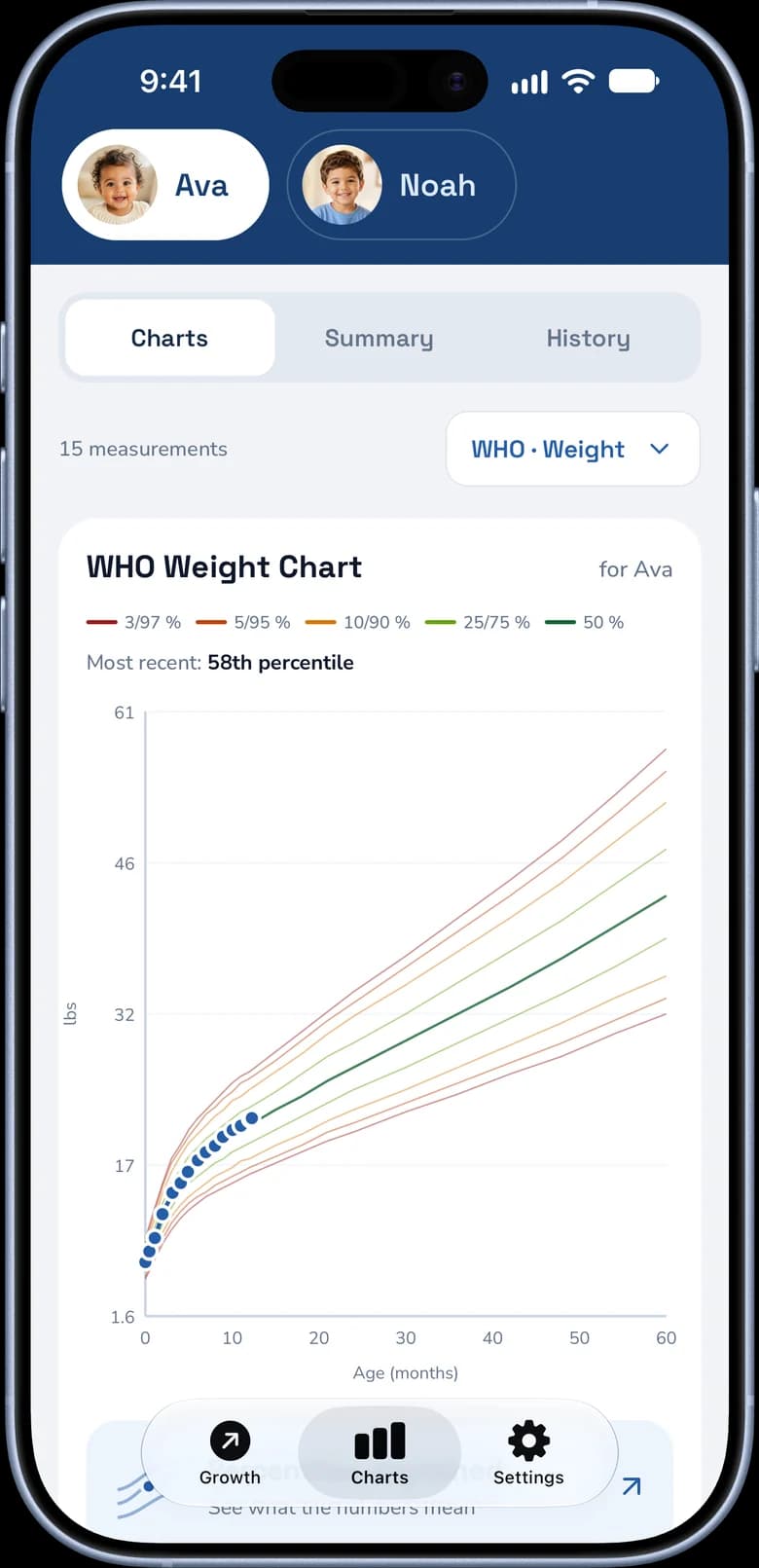
Plot every measurement on the WHO charts.
Percentiles, growth velocity and a PDF for your pediatrician. Free to download, with a free trial.

Common mistakes that make length read short
Home lengths tend to come out too short. Even the trained teams who measured babies for the WHO growth standards tended to underestimate length, "likely due to difficulties associated with keeping children fully stretched out and still" (WHO MGRS).
| Mistake | Effect | Fix |
|---|---|---|
| Knees bent | Reads short | Person 2 presses gently on the knees until the legs are flat |
| Head not touching the board, or chin tucked | Reads short | Person 1 keeps the crown against the board, baby looking straight up |
| Toes pointed instead of feet flat on the board | Inconsistent; usually reads long if you measure to the toes | Hold the feet flat against the footboard, toes up |
| Footboard tilted, or a pencil mark on a sheet that slides | Either direction | Use an upright board and measure board to board |
| Soft surface (bed, changing pad) | Either direction | Measure on a table or the floor |
| Tape laid along the curve of the body | Reads long | Measure in a straight line between the boards |
| Hair bun, clip or hat | Reads long | Remove them first |
| One person trying alone | Usually reads short | Wait until a second adult can help |
Here's how much a slightly bent knee can matter. A girl measures 70.3 cm at 9 months, about the 53rd percentile. A month later the home reading is 70.4 cm, which would put her at the 33rd percentile and suggest she barely grew. Measured again with her knees properly flat, she's 71.6 cm, back at the 52nd percentile. One surprising reading is much more likely to be technique than a growth problem. Measure again before you worry.
Why babies are measured lying down until 24 months
US pediatricians measure length lying down for children under 24 months and standing height from 24 months, and they switch from the WHO charts to the CDC charts at the same age (CDC). The WHO length-for-age standards also cover length for the first two years and height after that.
Lying-down length is about 0.7–0.8 cm greater than standing height for the same child, so a 2-year-old can seem about 1 cm shorter at the checkup where the method changes (CDC). That's a change in method, not lost growth. If a child under 2 can't lie down for a measurement, the AAP's clinic guidance is to measure standing height and add 0.7 cm. In your own records, note which method you used each time.
How often to measure, and how to read the number
Monthly is plenty, and leaving length to well-child visits is fine too: length is measured at every one (Bright Futures). After the first few months, monthly growth is small. The median girl is 70.1 cm (27.6 in) at 9 months and 71.5 cm (28.1 in) at 10 months. That gap is about the size of the bent-knee error above, which is why one measurement tells you little and a trend over several months tells you a lot.
To make sense of a measurement:
- Check the percentile for your baby's age and sex on the WHO chart. Compare with typical values in our average baby height by month table.
- Look at the trend, not the single number. To see it, plot several dated lengths on the WHO chart. Healthy babies settle near one percentile line and follow it. Some shifting in the first two years is common (AAFP).
- Check the growth rate over at least a few months. In the first year, babies typically grow 23–27 cm (9–11 in); in the second year, 10–14 cm (4–6 in) (AAFP).
Free tool
Baby Height Percentile Calculator
Enter your baby's age, sex and length to see their WHO length percentile.
Free tool
Baby Height Growth Velocity Calculator
Enter two length measurements to see how fast your baby is growing compared with typical rates.
If you log lengths in GrowthKit, the iPhone app we make, each one is plotted on the WHO length chart, and you can add a note such as "home, two people" or "fussy, one leg" so you know later how much to trust it. For how to read percentile lines, see how to read a child growth chart.
When to call your pediatrician
| What you see | What to do |
|---|---|
| One home reading lower than expected | Measure again with two people before drawing conclusions |
| Length falling across two major percentile lines over several months | Book a visit to have it measured on the office board |
| Length below the 2nd percentile line or above the 98th on your baby's chart | Ask at the next visit (sooner if it's new) |
| Length steady but weight falling, or the reverse | Book a visit; weight and length are judged together |
| A steady line, even a low or high one | Keep tracking; bring your numbers to the next checkup |
The office measurement is the reference. Bring your home numbers, labeled as home measurements, and our guide to sharing baby growth data with your pediatrician covers how to present them.