
Girls have their biggest growth spurt around age 11½ and boys around 13½, roughly two years later (MedlinePlus). At the peak, girls grow about 8–12 cm (3–5 in) in a year and boys about 10–14 cm (4–6 in), the fastest growth since early childhood (AAFP). For the years before and after the spurt, see how much kids grow per year.
The spurt is part of puberty, so its timing follows puberty's timing. A girl who starts developing at 8 will spurt earlier than one who starts at 12, and both are normal. The table below gives the typical ages, followed by an example teen growth curve and the signs that puberty is early or late enough to check.
Growth spurt ages at a glance
| Girls | Boys | |
|---|---|---|
| Puberty usually starts | Ages 8–13 (average about 10½) | Ages 9–14 (average about 11½) |
| First sign | Breast buds | Testicles get larger |
| Fastest growth (peak) | Around 11½, early in puberty | Around 13½, late in puberty |
| Growth at the peak | About 8–12 cm (3–5 in) a year | About 10–14 cm (4–6 in) a year |
| Growth slows down | After the first period (median age 12–13); most girls grow another 1–2 in | Growth spurt slows around 18 |
Sources: Endocrine Society (puberty ages), HealthyChildren.org (first signs, growth after the first period), MedlinePlus (peak ages), AAFP (peak growth rates), ACOG (age at first period).
Two things stand out. Girls spurt early in puberty: the fastest growth usually comes between the first breast buds and about six months before the first period (HealthyChildren.org). Boys spurt late in puberty, after the testicles and genitals have already started to change (HealthyChildren.org). That's why a 13-year-old girl is often taller than the boys in her class, and why many boys are still growing in their late teens.
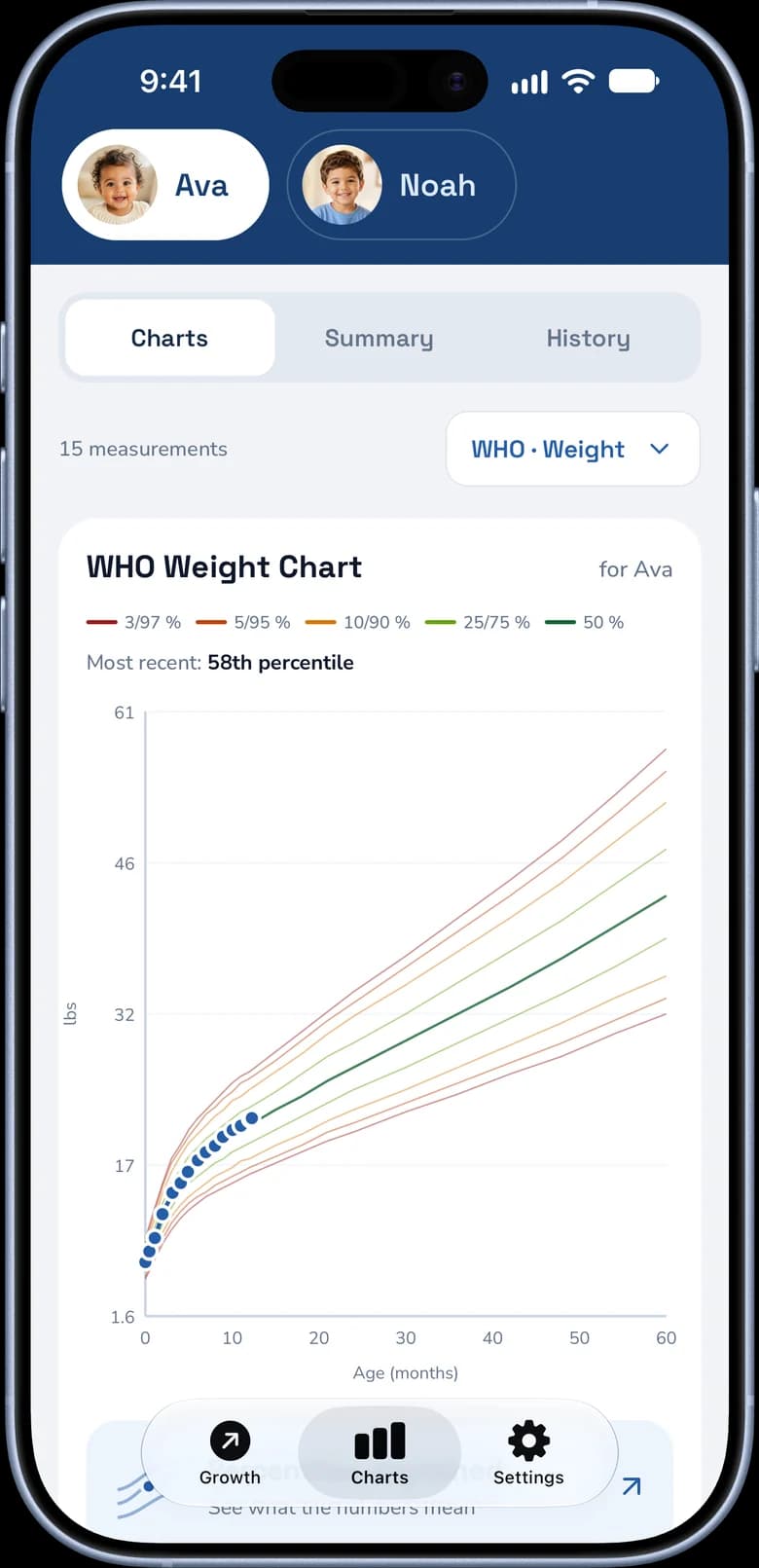
GrowthKit for iPhone
Plot every measurement on the WHO charts.
Percentiles, growth velocity and a PDF for your pediatrician. Free to download, with a free trial.

What a teen growth spurt looks like on a growth chart
From age 2, US pediatricians plot height on the CDC growth charts. Those curves are drawn from thousands of children who each hit their spurt at a different age, so they rise more gently than any single child does. A child who spurts early climbs above their usual line for a while, then settles back as classmates catch up.
Stature-for-age, girls, 8 years to 18 years
At 10 she is 138 cm (4 ft 6¼ in), right on the 50th percentile. She then grows 7.5 cm in a year and 8.5 cm the year after, a normal peak for a girl. By 12 she's 154 cm, at the 65th percentile, taller than most girls her age. After that her growth slows to 5 cm, then 2 cm, then less than 1 cm a year. At 16 she's 162 cm (5 ft 3¾ in), back near the 47th percentile, because the girls who spurted later have caught up.
Nothing about this curve is a problem. A temporary climb during an early spurt, or a temporary dip in a late developer, is the most common reason a healthy teen's percentile changes. What matters is that growth keeps going and puberty is moving along. For the details by sex, see when do girls stop growing and when do boys stop growing.
Growth before puberty: steady, not spurts
Between the toddler years and puberty, children grow at a fairly steady rate that slowly drops. Typical height gain is (AAFP):
| Age | Typical height gain per year |
|---|---|
| First year | 23–27 cm (9–11 in) |
| Second year | 10–14 cm (4–6 in) |
| Fourth year | 6–7 cm (2–3 in) |
| Just before puberty (the slowest point) | 5–5.5 cm (about 2 in) |
| Puberty peak | Girls 8–12 cm (3–5 in); boys 10–14 cm (4–6 in) |
So the pre-puberty years are the slowest of childhood, and the spurt roughly doubles that rate. Boys and girls grow at similar speeds until girls start puberty. Because boys start about two years later, they get two more years of childhood growth before their spurt, then a stronger one.
Babies do have short hungry, fussy spells that parents call growth spurts, often around 1–3 weeks, 6 weeks, 3 months and 6 months. Those ages come from parent reports rather than measured growth. Our guide to baby growth spurts covers what to expect and how to handle them.
Signs of a growth spurt (and what isn't one)
Common signs during the puberty spurt:
- Bigger appetite. Many teens eat noticeably more while they're growing fast.
- Shoes and pants that suddenly don't fit.
- Temporary clumsiness. As height and weight shift, the brain has to adjust, and the AAP notes a temporary decline in balance and body control during the spurt (HealthyChildren.org).
- Higher injury risk at the growth plates. The growth plate is weakest during the fastest growth, so falls and repetitive throwing or tumbling can injure it. Pain over a joint after a sports injury should be checked.
Growing pains are not a sign of growth. Despite the name, they "are not caused by rapid growth or growth spurts," according to the American College of Rheumatology. They're common between about ages 3 and 14, usually in the legs, and usually late in the day or at night. See a doctor if the pain is constant or getting worse, stays in the same spot, or comes with morning joint stiffness, swelling, redness or limping.
Sleep and food during a growth spurt
Children need enough sleep at every age, spurt or not. The American Academy of Sleep Medicine's recommendations, which the AAP endorses, are per 24 hours including naps (AASM):
| Age | Recommended sleep per 24 hours |
|---|---|
| 1–2 years | 11–14 hours |
| 3–5 years | 10–13 hours |
| 6–12 years | 9–12 hours |
| 13–18 years | 8–10 hours |
For what sleep does and doesn't do for height, see sleep and child growth.
There's no special diet for a growth spurt. Let your child's appetite lead and offer regular meals and snacks with protein, dairy or fortified alternatives, fruit, vegetables and whole grains. A teen who is restricting food, especially in a sport that rewards being light, can grow less than expected and should see their pediatrician. For how sports fit in, see whether exercise affects a child's height.
When puberty timing is worth a call
Puberty that starts very early or very late is usually a normal variation, but it should be checked, because a few causes are treatable and timing affects how much growing time is left.
| What you notice | What to do |
|---|---|
| Breast development before 8, or testicles enlarging before 9 | Call your pediatrician; see precocious puberty signs |
| A girl with no breast development by 13 | Book a visit (HealthyChildren.org) |
| A boy with no signs of puberty by 14 | Book a visit (MedlinePlus) |
| A girl with no period by 15, or by 14 with no other signs of puberty | Book a visit (MedlinePlus) |
| Height falling across two major percentile lines after age 2, or growth that seems to have stopped early | Book a visit (AAFP) |
| A steady line and puberty within the ages above | Nothing to do; keep measuring every 3–6 months |
The most common cause of late puberty in boys is constitutional delay, a "late bloomer" pattern that runs in families (MedlinePlus). Once puberty starts, it progresses normally.
How to track a growth spurt at home
Measure your child standing, barefoot, against the same wall every 3–6 months, using a flat book held level on the head. Write down the date each time. To get growth per year, divide the gain by the number of months between measurements and multiply by 12. A child who grows 3 cm in 4 months is growing at about 9 cm a year, which is spurt speed. You can also calculate growth per year from two heights.
Free tool
Child Height Percentile Calculator
Check where your child's height falls on the CDC chart for their age and sex.
If you log heights in GrowthKit, the iPhone app we make, each one is plotted on a WHO height chart (it covers up to age 19), and the app draws a growth velocity chart so you can see the spurt start and slow. Your pediatrician will use the CDC chart, so treat the app as a record to bring along, not a diagnosis.
To estimate where your child is heading, the mid-parental height formula is a good start: see how to predict your child's adult height.
Free tool
Child Height Prediction Calculator
Estimate your child's adult height range from both parents' heights.