In the first 2 months, a typical baby gains roughly 1 kg (2 lb) a month or a bit more, which works out to about 7½–9 oz (215–255 g) a week. Gain then slows steadily: about 4 oz (115 g) a week at 4–5 months, 3 oz (80 g) at 6–7 months and about 2 oz (55 g) a week by the first birthday. These are the medians from the WHO weight velocity standards, and healthy babies vary widely around them.
The tables below show the typical gain and the normal range for each month of the first year. After them you'll find worked examples, and the signs that gain is too slow or too fast.
How much weight should a baby gain per month?
Each row shows how much weight babies put on during that month: the median, and the range that covers 90% of healthy babies (5th to 95th percentile).
| Age | Boys: median | Boys: 5th–95th | Girls: median | Girls: 5th–95th |
|---|---|---|---|---|
| Birth–4 weeks | 1,023 g (36 oz) | 460 to 1,509 g (16 to 53 oz) | 879 g (31 oz) | 446 to 1,348 g (16 to 48 oz) |
| 4 weeks–2 months | 1,196 g (42 oz) | 713 to 1,724 g (25 to 61 oz) | 1,011 g (36 oz) | 578 to 1,476 g (20 to 52 oz) |
| 2–3 months | 815 g (29 oz) | 446 to 1,228 g (16 to 43 oz) | 718 g (25 oz) | 369 to 1,094 g (13 to 39 oz) |
| 3–4 months | 617 g (22 oz) | 285 to 985 g (10 to 35 oz) | 585 g (21 oz) | 259 to 937 g (9 to 33 oz) |
| 4–5 months | 522 g (18 oz) | 194 to 883 g (7 to 31 oz) | 489 g (17 oz) | 172 to 833 g (6 to 29 oz) |
| 5–6 months | 422 g (15 oz) | 103 to 773 g (4 to 27 oz) | 401 g (14 oz) | 93 to 739 g (3 to 26 oz) |
| 6–7 months | 357 g (13 oz) | 42 to 706 g (1 to 25 oz) | 344 g (12 oz) | 37 to 684 g (1 to 24 oz) |
| 7–8 months | 316 g (11 oz) | 0 to 671 g (0 to 24 oz) | 311 g (11 oz) | 0 to 659 g (0 to 23 oz) |
| 8–9 months | 285 g (10 oz) | −36 to 646 g (−1 to 23 oz) | 273 g (10 oz) | −40 to 623 g (−1 to 22 oz) |
| 9–10 months | 259 g (9 oz) | −66 to 627 g (−2 to 22 oz) | 245 g (9 oz) | −70 to 598 g (−2 to 21 oz) |
| 10–11 months | 243 g (9 oz) | −89 to 623 g (−3 to 22 oz) | 233 g (8 oz) | −89 to 598 g (−3 to 21 oz) |
| 11–12 months | 239 g (8 oz) | −106 to 635 g (−4 to 22 oz) | 232 g (8 oz) | −102 to 612 g (−4 to 22 oz) |
Source: WHO Child Growth Standards: weight velocity, 1-month weight increments (5th, 50th and 95th percentiles), rounded to the nearest ounce. The first row runs from birth, so it includes the normal weight loss of the first days.
Three things stand out:
- Gain peaks in the first 2 months, then roughly halves by 4–5 months.
- Boys gain a little more than girls, which is why each sex has its own chart.
- From about 7 months, the low end of the range reaches zero. About 1 in 20 healthy babies gains little or nothing in a given month, or loses a few ounces. A slow month on its own isn't alarming at this age. A run of them, or a steady slide down the percentile lines, is. For more on this stage, see why weight gain slows after 6 months.
The WHO standards are built on healthy breastfed babies, the model against which all babies are compared (CDC MMWR).
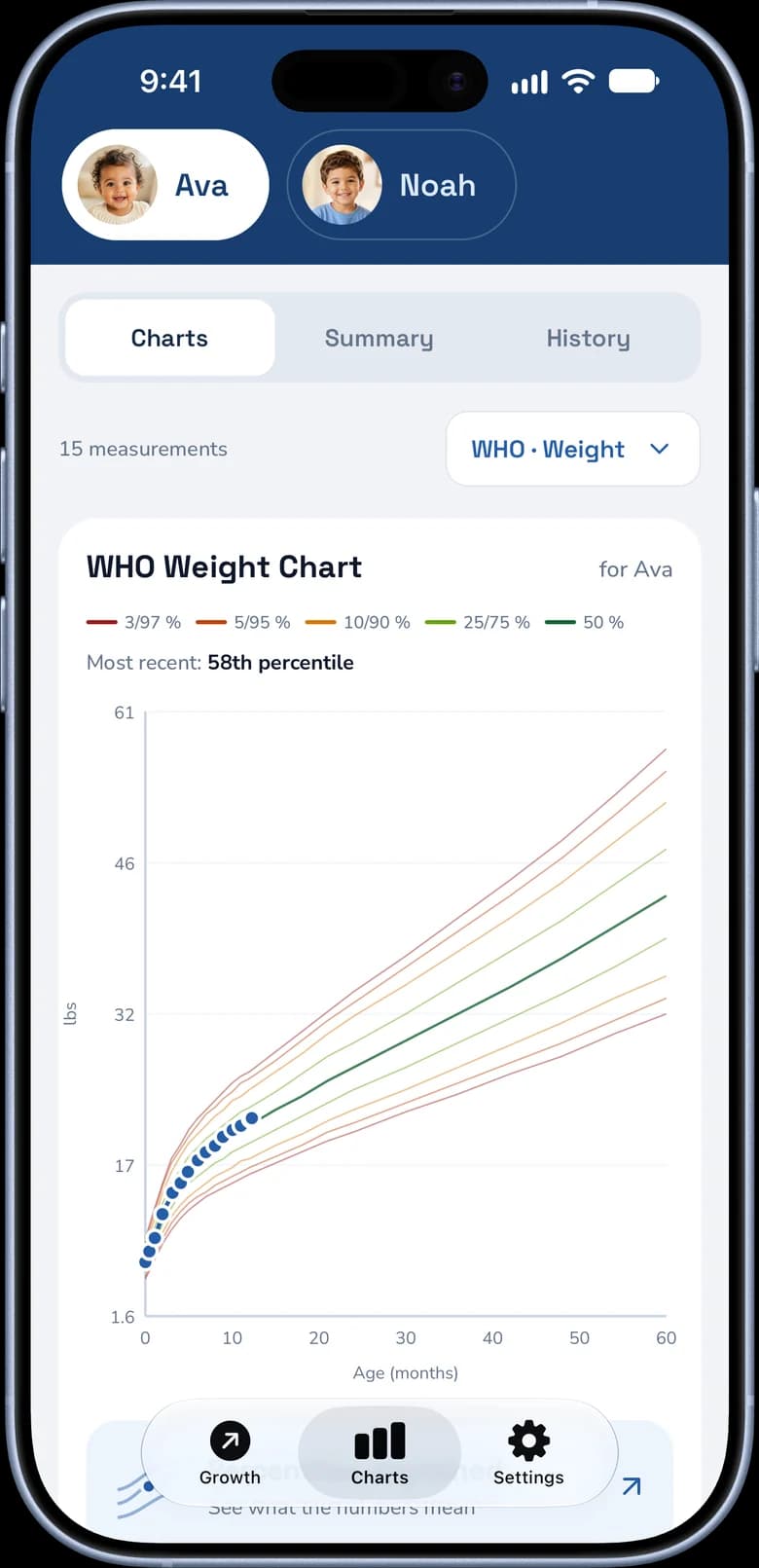
GrowthKit for iPhone
Plot every measurement on the WHO charts.
Percentiles, growth velocity and a PDF for your pediatrician. Free to download, with a free trial.

How much weight should a baby gain per week?
Weekly numbers are easier to picture, but they're only averages. A single week's gain swings a lot with feeds, diapers and the scale, so compare weights a few weeks apart.
| Age | Boys | Girls |
|---|---|---|
| Birth–1 month | 9 oz (256 g), including the newborn dip | 7¾ oz (220 g), including the newborn dip |
| 1–2 months | 9 oz (255 g) | 7½ oz (215 g) |
| 2–4 months | 5–6½ oz (142–187 g) | 4¾–6 oz (135–165 g) |
| 4–6 months | 3½–4¼ oz (97–120 g) | 3¼–4 oz (92–112 g) |
| 6–9 months | 2¼–3 oz (66–82 g) | 2¼–2¾ oz (63–79 g) |
| 9–12 months | About 2 oz (55–60 g) | About 2 oz (53–56 g) |
Source: calculated from the WHO weight velocity standards by dividing each 1-month median gain by the number of weeks in that month.
These match the median daily gains summarized by the American Academy of Family Physicians: about 26–31 g a day from birth to 3 months, 17–18 g at 3–6 months, 12–13 g at 6–9 months and 9 g at 9–12 months.
Free tool
Baby Weight Growth Velocity Calculator
Enter two weights and dates to see your baby's gain per week and per month.
The first two weeks: weight loss, then regain
All newborns lose some weight in their first days. According to the American Academy of Pediatrics, babies start gaining steadily around day 5 and are back to their birth weight by about 2 weeks. Almost all have regained it by 3 weeks. Over the first month, the average newborn gains almost 1 oz (28 g) a day.
Check in with your pediatrician if:
- Your baby has lost 10% or more of their birth weight. A well-fed newborn loses no more than about 8–10% before gaining again (AAP), so a bigger loss calls for a feeding check (Flaherman et al., Pediatrics 2015).
- Your baby isn't back to birth weight by 2 weeks.
- By 2 weeks, a breastfed baby hasn't started gaining at least 5–7 oz a week since your milk came in. The AAP lists this among its warning signs of breastfeeding problems.
That 5–7 oz threshold lines up with the WHO data. Between 2 and 6 weeks of age, only 1 in 20 healthy babies in the WHO study gained less than about 250–350 g (9–12 oz) in a two-week stretch. Our guide to newborn weight loss after birth covers the first days in detail.
Worked examples: is this gain normal?
A steady gainer. A boy weighs 12 lb (5.44 kg) at 2 months and 14 lb (6.35 kg) at 3 months. He gained 2 lb (907 g) in a month, or about 7½ oz a week. The WHO median for boys at 2–3 months is 815 g, so he's a little above average and well inside the normal range. His weight percentile moved from the 43rd to the 49th, so he's holding his line. Normal.
Slowing down on schedule. A boy weighs 17 lb 8 oz (7.94 kg) at 6 months and 20 lb 2 oz (9.13 kg) at 9 months. That's 2 lb 10 oz (1,190 g) in 3 months, or about 400 g a month. The WHO medians for those months are 285–357 g, so he's gaining slightly faster than average even though his gain is less than half what it was at 2 months. His percentile went from the 50th to the 59th. Normal.
Two slow months in a row. A girl has followed the middle of the chart since birth. She weighs 6.4 kg at 4 months, 6.5 kg at 5 months and 6.6 kg at 6 months.
Weight-for-age, girls, birth to 12 months
She gained only 100 g in each of those months. For girls, that's below the WHO 3rd percentile for gain at 4–5 months (130 g) and near the 5th percentile at 5–6 months (93 g). Her percentile slid from the 49th to the 20th. None of her weights is low, and she hasn't yet crossed two major lines. But two months in a row at the very bottom of the WHO range is unusual, so it's worth booking a weight check and talking through feeding rather than waiting for the next routine visit.
When is weight gain too slow?
Slow gain matters most when it's sustained and pulls a baby down across the chart. Call your pediatrician if:
- Your newborn isn't back to birth weight by 2 weeks (see above).
- A baby under 4 months hasn't gained anything over 2 weeks. At that age, even the slowest-gaining 1% of healthy babies in the WHO study still put on more than 130 g (4½ oz) a month.
- Weight has fallen across two major percentile lines, the usual trigger for an evaluation (AAFP).
- Your baby is losing weight outside of a short illness, or is feeding poorly, or has fewer wet diapers than usual.
The most common reason for slow gain is simply not getting enough calories, whether from a latch or milk-supply problem, a feeding difficulty or incorrectly prepared formula (AAFP). That's why your pediatrician will usually start by asking about feeding.
Breastfed babies usually gain a little more slowly than formula-fed babies after about 3 months, and the CDC calls slower growth in breastfed babies between 3 and 18 months normal. If a breastfed baby does seem to be gaining too slowly, the CDC advises checking the baby's general health and how breastfeeding is going before formula is considered (CDC MMWR).
For a full by-age list of red flags, see when to worry about baby weight. If your baby has already dropped across lines, read why babies drop on the growth chart.
When is weight gain too fast?
Rapid gain gets less attention than slow gain, but it's also worth discussing. The CDC notes that formula-fed babies tend to gain faster than the WHO curves after about 3 months, and that gaining weight more rapidly than the WHO charts show "might signal early signs of overweight."
The research behind that concern:
- In a UK cohort of 848 babies, those whose weight rose by more than 0.67 standard deviations between birth and age 2 (about the distance from the 50th to the 75th percentile) were heavier and had more body fat at age 5 (Ong et al., BMJ 2000).
- A pooled analysis of 47,661 people from 10 cohorts found that each 1 standard deviation rise in weight during the first year roughly doubled the odds of childhood obesity and raised the odds of adult obesity by about 23% (Druet et al., 2012).
That's an association, not a verdict. Many babies who climb the chart were small at birth and are catching up, which is expected. Here's a boy who climbs steadily:
Weight-for-age, boys, birth to 12 months
He goes from the 29th percentile at 2 months to the 83rd at 6 months and the 86th at 9 months, crossing the 50th and 85th lines. Each weight on its own is within the normal range, but the climb is worth raising at his next visit.
If your baby is climbing the chart:
- Don't restrict feeds or water down formula. Talk to your pediatrician first. They'll check length and weight-for-length, not just weight.
- Follow your baby's cues. The AAP's advice is to "let them tell you when they've had enough": a baby who gets fidgety or easily distracted during a feed is probably finished (AAP).
- Know the usual ceiling for formula. The AAP says babies usually drink no more than about 32 oz (960 mL) of formula a day on average. If yours consistently wants more, discuss it with your pediatrician.
- Mix formula exactly as the label says, so every bottle has the calories it should.
Signs of healthy gain beyond the scale
Weight is only one sign that feeding is going well. For breastfed newborns, the AAP looks for:
- Nursing at least 8–12 times every 24 hours.
- By 5–7 days old, 6 or more wet diapers a day with pale yellow or nearly clear urine.
- By 5–7 days old, at least 3–4 loose yellow stools a day.
- Seeming satisfied for an average of 1–3 hours between feeds.
Older babies who are alert, active, feeding well and growing in length are usually getting enough, even when a month's weight gain looks small.
What about doubling and tripling birth weight?
Rules of thumb such as "double birth weight by 6 months" or "triple it by 12 months" aren't used to diagnose anything. Babies who start small often double sooner, and big babies later. Your pediatrician looks at the growth curve and the rate of gain instead. If you're curious, our average baby weight by month guide shows when the WHO medians double and triple.
Tracking weight gain between visits
Babies are weighed at every well-child visit, but those can be 2–3 months apart. If you weigh at home, use the same scale at the same time of day, with your baby in a dry diaper or nothing. Monthly weights tell you far more than daily or weekly ones.
GrowthKit plots each weight on the WHO chart and shows a weight velocity chart (grams or ounces gained per month), so a slowdown or a steep climb is easy to spot before a visit. To check a single stretch, use the calculator below.
Free tool
Baby Weight Gain Since Birth Calculator
See how much weight your baby has gained since birth and how it compares with typical gain.