
Call your pediatrician the same day if your newborn has lost 10% or more of their birth weight or isn't back to birth weight by 2 weeks, if a baby of any age is losing weight outside a short illness, or if their weight has fallen across two major percentile lines. Get care right away for signs of dehydration, a baby who is very hard to wake, or green vomit. A baby who is small but growing steadily along their own curve is usually healthy.
The table below sorts the common situations by age and urgency. After it you'll find three worked examples with real numbers.
Baby weight red flags by age
| Age | Usually normal | Mention at the next visit | Call your pediatrician today | Seek care now |
|---|---|---|---|---|
| Birth to 2 weeks | Loses weight in the first days, starts gaining around day 5, back to birth weight by about 2 weeks | Feeding questions (newborns are usually checked within 2 days of leaving the hospital) | Lost 10% or more of birth weight; not back to birth weight by 2 weeks; after day 7, fewer than 6 wet diapers a day; doesn't seem to swallow during feeds | Very sleepy and hard to wake for feeds; signs of dehydration; green vomit; fever of 100.4°F (38.0°C) or higher |
| 2 weeks to 4 months | Gains about 5–9 oz (135–255 g) a week and follows roughly the same percentile line | Drifting across one major percentile line while still gaining | No gain over 2 weeks; weight lower than at the last weigh-in; fallen across two major lines; feeding poorly or fewer wet diapers | Signs of dehydration; very sleepy or floppy; green vomit; fever of 100.4°F (38.0°C) or higher under 3 months |
| 4 to 12 months | Gain slows to about 3–4 oz (90–120 g) a week at 4–6 months and about 2 oz (55 g) by 12 months; an occasional slow month | A slow month in a well baby; drifting across one major line, or climbing quickly across lines; weight below the 2nd or above the 98th percentile line | Losing weight outside a short illness; fallen across two major lines; refusing most feeds | Signs of severe dehydration; very sleepy or hard to wake; green vomit |
| 12 to 24 months | Gains about 2.5 kg (5½ lb) over the whole year; appetite drops and varies from day to day | Picky eating with a steady curve; drifting across one major line; weight below the 2nd or above the 98th percentile line | Losing weight outside a short illness; fallen across two major lines | Signs of severe dehydration; very sleepy or hard to wake; green vomit |
Sources: birth-weight regain from the AAP; newborn feeding signs from the AAP's breastfeeding warning signs; typical gain from the WHO weight velocity standards; percentile lines from the AAFP and CDC.
A few terms in the table:
- A major percentile line is one of the main curves printed on the chart your pediatrician uses. WHO's own charts show the 3rd, 15th, 50th, 85th and 97th. Falling across two of them is the usual trigger for an evaluation (AAFP). Our guide to babies who drop on the growth chart explains how to count lines.
- The 2nd and 98th percentile lines on US charts are really the 2.3rd and 97.7th percentiles, the cutoffs the CDC recommends for flagging unusually low or high growth under age 2. Ask sooner than the next visit if your baby's weight has newly fallen outside them.
- Signs of dehydration include fewer than 6 wet diapers a day, a dry mouth, fewer tears and a sunken soft spot. The AAP says to notify your pediatrician immediately if any appear. Severe signs, such as being excessively sleepy, sunken eyes, cool or discolored hands and feet, or peeing only once or twice a day, need care right away (AAP).
- Green vomit (the color of bile) is an emergency in a baby: go to the ER (AAP). A fever of 100.4°F (38.0°C) or higher in a baby under 3 months means calling your pediatrician right away (AAP).
For the full month-by-month gain figures, see baby weight gain per month.
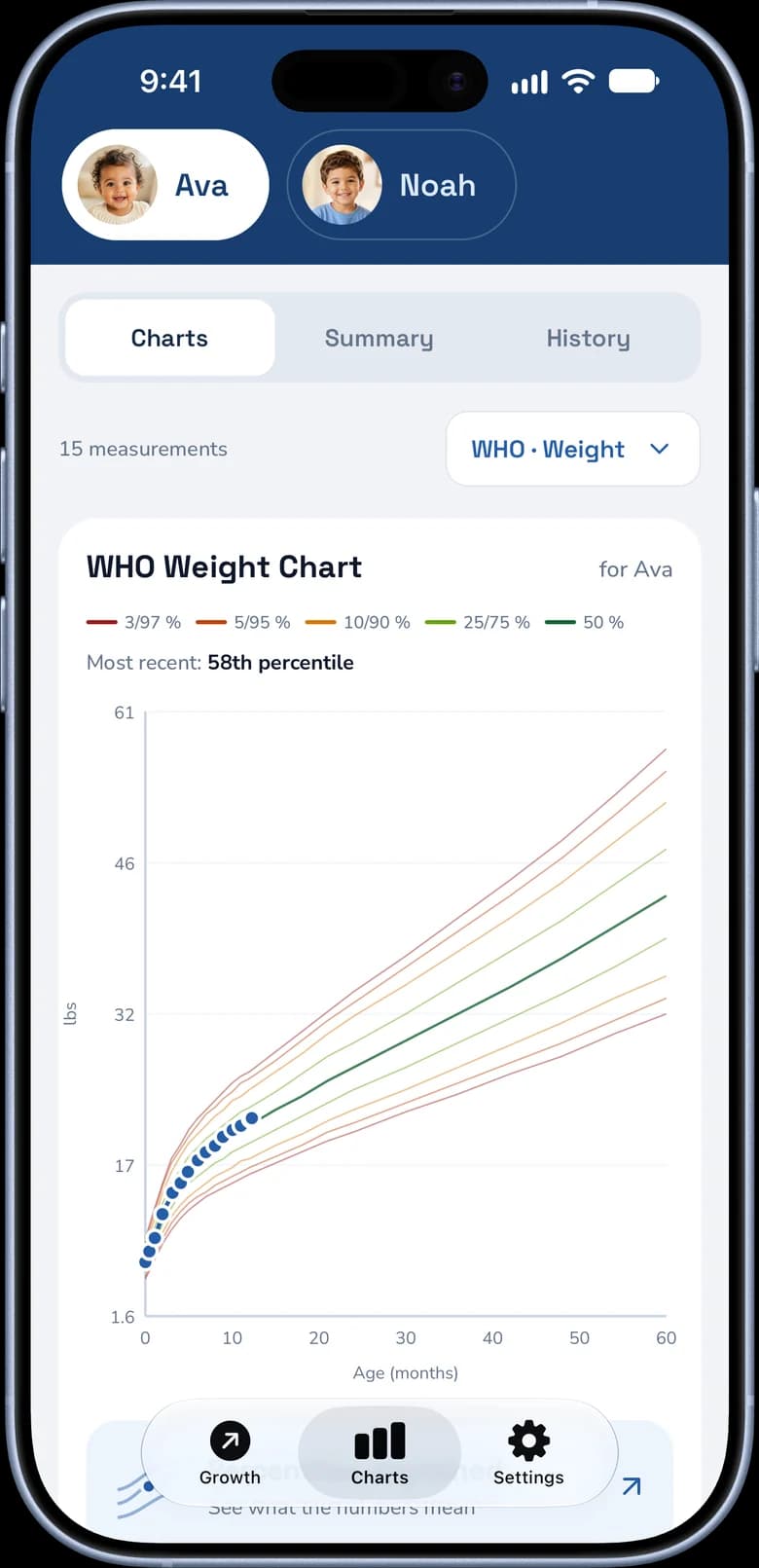
GrowthKit for iPhone
Plot every measurement on the WHO charts.
Percentiles, growth velocity and a PDF for your pediatrician. Free to download, with a free trial.

Three examples with real numbers
A newborn who isn't back to birth weight
A baby girl is born at 3.5 kg (7 lb 11 oz). On day 3 she weighs 3.2 kg (7 lb 1 oz), a loss of 300 g or about 9%. That's at the high end of normal, so her pediatrician checks feeding and asks to see her again soon. At 2 weeks she weighs 3.4 kg (7 lb 8 oz). She's gaining, but she still isn't back to her birth weight, which most babies reach by about 2 weeks (AAP). Call today. A weight check and a feeding review, often with a lactation consultant, are the usual next steps.
A small baby growing steadily
Weight-for-age, girls, birth to 12 months
This girl was born at 2.7 kg, about the 11th percentile. At 6 months she weighs 6.2 kg (9th percentile) and at 12 months 7.8 kg (13th percentile). She's smaller than most babies her age, but she follows the same line all year, inside the normal range. If she's feeding well and meeting milestones, nothing to do beyond routine visits. For a quick check that covers length and head size too, see whether your baby is growing normally.
A baby drifting down across two lines
Weight-for-age, boys, birth to 12 months
This boy weighs 5.8 kg at 2 months, the 63rd percentile. He keeps gaining, just less each month than babies his age usually do. At 4 months he's at the 45th percentile, at 6 months the 26th and at 9 months the 14th. None of his weights is low on its own, but he has now fallen across the 50th and 15th lines. Call today to book a weight check rather than waiting for the 12-month visit. Often the answer turns out to be a change in feeding rather than tests. To spot this kind of drift in your own baby's numbers, plot each dated weight on the WHO chart.
Common situations, and how worried to be
Weight loss during an illness. After the newborn period, babies shouldn't steadily lose weight, but a small dip during a short illness is common. A baby with a stomach bug or a cold that makes feeding hard may lose a little and regain it once they're eating normally. Call if the loss continues, your baby isn't regaining after recovering, or you see signs of dehydration.
Short or long feeds. Feed length alone is a weak guide. The AAP lists breastfeeds that are consistently shorter than about 10 minutes, or longer than about 50 minutes, in the first few months as a possible sign that a baby isn't getting enough milk (AAP). If you notice that pattern, ask for a weight check. Steady weight gain, audible swallowing and plenty of wet diapers tell you more than the clock does.
Weight that seems out of proportion to length. Comparing a weight percentile with a length percentile is not a reliable test. Pediatricians use a separate weight-for-length chart. On WHO charts, the CDC uses the same 2nd and 98th lines (2.3rd and 97.7th percentiles) as cutoffs, and some definitions of failure to thrive use weight-for-length below the 5th percentile (AAFP). You can check it with our baby weight-for-length calculator.
A low but steady percentile. A baby who stays near the same low line, like the girl above, is usually growing normally. Many babies shift toward their family's size during the first 18 months or so, then follow that line (AAFP). Our guide to babies in a low percentile covers what doctors check.
Gaining fast. Climbing across percentile lines is worth raising at the next visit. Formula-fed babies tend to gain faster than the WHO curves after about 3 months, and rapid gain is linked with later overweight (CDC MMWR). Don't restrict feeds on your own. Our weight gain guide covers what to discuss.

Free tool
Growth Concern Red Flags Checker
Go through a checklist of signs that a baby's growth needs a prompt look from the pediatrician.
What happens after you call
Your pediatrician will usually reweigh your baby on a calibrated scale, look at the whole growth record, ask about feeding and examine your baby. The most common cause of poor weight gain is not getting enough calories, and routine lab tests are rarely needed (AAFP). Most babies need a feeding plan and a few follow-up weight checks.
For more detail on what comes next:
- Why babies drop on the growth chart: common causes and how pediatricians sort them out.
- Failure to thrive in babies: what the diagnosis means and how it's treated.
- Toddler not gaining weight: the same question after the first birthday.
What to bring to the appointment
- Every weight you have, with dates, including any from home or the pharmacy. GrowthKit can export your baby's measurements and WHO charts as a PDF report for the visit.
- A note of a typical day: how often your baby feeds, roughly how much for bottles, and how many wet and dirty diapers.
- Anything else you've noticed, such as vomiting, diarrhea, breathing fast during feeds, or a change in alertness.
If something feels wrong, call even when the numbers look fine. You know your baby, and pediatricians would rather hear from you early. If the worry itself is wearing you down, read about handling guilt over your baby's weight.
Free tool
Baby Weight Percentile Calculator
Check your baby's exact WHO weight percentile before or after a weigh-in.